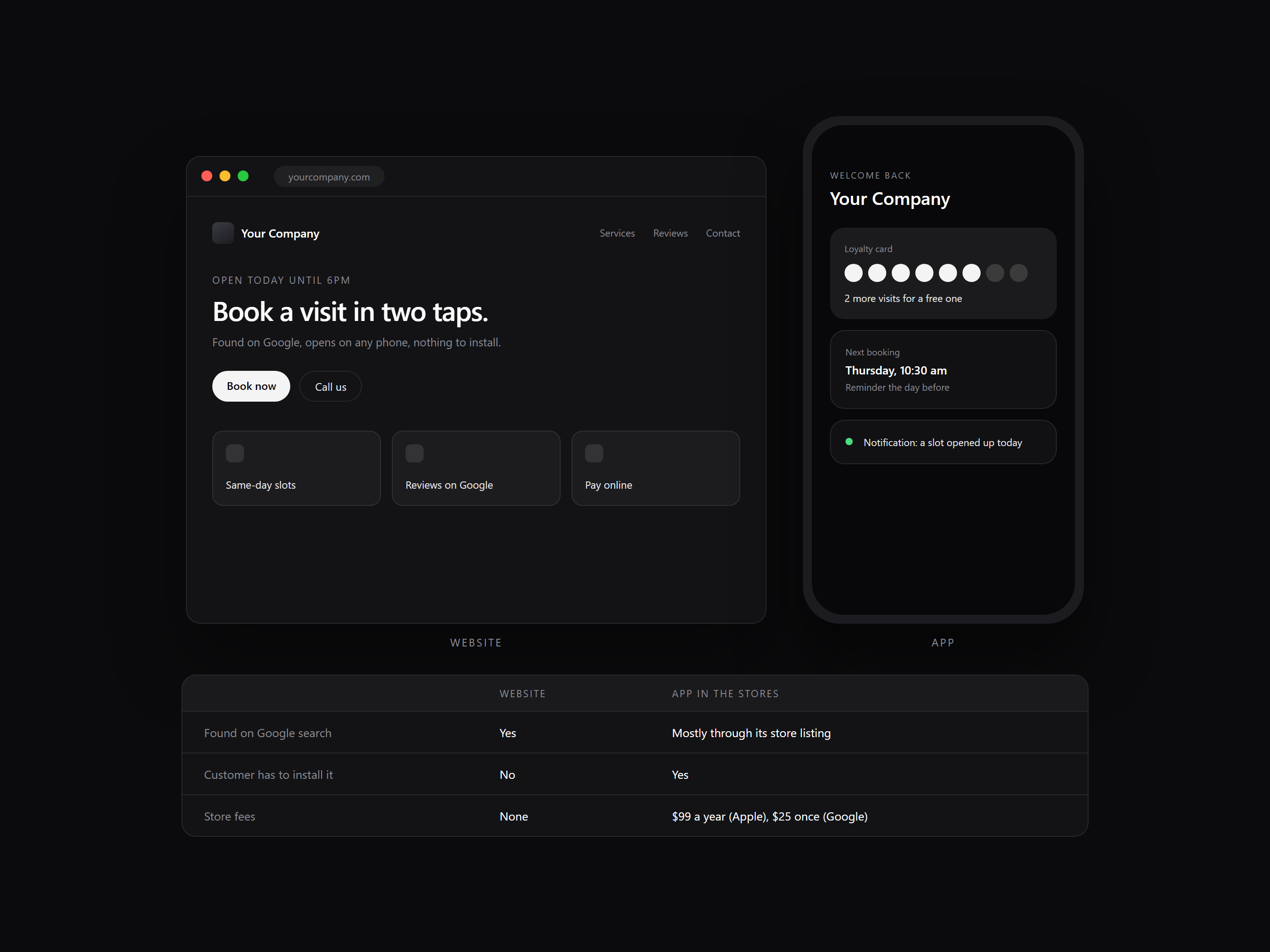
Most small businesses do not need an app first. They need a website that loads fast on a phone, shows up on Google, and lets a customer book or buy in a few taps. An app becomes worth it when the same customers come back again and again, and you want to be one tap away on their home screen.
Key Takeaways
- A website reaches anyone with a browser. An app mostly reaches people who already like you enough to install it.
- Apple is likely to reject an app that is just your website repackaged, so an app has to do something a website does not do well.
- Being in the stores costs $99 a year for Apple and a one-time $25 for Google, before any build cost.
- Apps pay off for repeat customers: memberships, loyalty, regular bookings, and staff or field tools.
Start with the website
For most local businesses, new customers come from Google search, not the App Store. They search on Google, tap a result, and decide in a few seconds whether to stay. That is a website's job, and an app cannot do it for you.
So before anything else, check the basics on your own phone:
- Does your site load quickly and look right on a phone?
- Can someone book, call, or buy within a couple of taps?
- Do you show up when you search for what you sell plus your city?
If any of those is a no, fix the website itself first. It is usually cheaper, and nearly every new customer sees it. If you are not sure where your site stands, that is exactly what a free project audit is for.
What an app does better than a website
An app earns its place when it gives your customers something a website does not do well:
- Push notifications. A reminder, an offer, or "your table is ready" lands on the lock screen instead of in an inbox.
- A spot on the home screen. Regulars open you in one tap instead of searching every time.
- Logged in by default. Their membership, points, history and saved payment are just there.
- Phone features. Camera, location, scanning, and working with spotty signal, which matters for staff and field tools.
If none of those would change how your customers behave, an app probably is not your next move.
Apple pushes back on websites wrapped in an app
Many owners do not expect this. Apple's own App Review Guidelines say your app "should include features, content, and UI that elevate it beyond a repackaged website" (guideline 4.2, App Review Guidelines, retrieved October 1, 2026). Guideline 4.2.2 adds that apps (other than catalogs) "shouldn't primarily be marketing materials, advertisements, web clippings, content aggregators, or a collection of links."
In plain terms: a cheap app that just shows your website inside a frame is likely to be rejected. If you build an app, it has to be a real product with its own reason to exist.
What it costs just to be in the app stores
These are the store fees, separate from what it costs to build the app:
- Apple: the Apple Developer Program is $99 per membership year (Apple, retrieved October 1, 2026). A business account also needs a D-U-N-S number.
- Google: a one-time $25 registration fee, plus identity verification (Google Play Console Help, retrieved October 1, 2026).
One fee most service businesses can relax about: Apple's commission. Apple's guidelines say that when your app sells physical goods or services used outside the app, you "must use purchase methods other than in-app purchase," such as Apple Pay or a regular card (guideline 3.1.3(e), App Review Guidelines, retrieved October 1, 2026). So a salon booking, a meal, or a repair paid through your app goes through your normal card processor, not Apple's in-app purchase system. The App Store commission applies to paid apps and digital in-app purchases, and developers who enroll in Apple's Small Business Program and earn up to $1 million in proceeds per calendar year pay 15% (Apple, retrieved October 1, 2026).
When an app is worth it
An app tends to pay off when at least one of these is true:
- Customers come back on a schedule. Gyms, salons, clinics, classes, and anything with weekly or monthly visits. Often an online booking system on your website covers this before an app does.
- You run a membership or loyalty program. Points, punch cards and member pricing are easier to use when they live on the phone.
- Ordering again should be instant. Restaurants, cafes and shops with a regular crowd.
- Your own staff need it. Field techs, drivers and crews logging jobs, photos and signatures on the go.
- The app is the product. You are selling a service that only works as an app.
If you nodded at one of these, an app is worth a serious look. If not, put the money into the website and your Google presence first.
A middle path: a website that behaves like an app
There is an option between the two. Most phones let you save a website to the home screen, and a well built site can feel close to an app, without going through either store. For many businesses, that plus a fast booking flow covers most of what they hoped an app would do, for less money and with no store review. Whether it is enough for you depends on how much you need the features in the list above, especially notifications and phone hardware.
| Website | Website saved to the home screen | App in the stores | |
|---|---|---|---|
| Found on Google search | Yes | Yes | Mostly through its store listing |
| Customer has to install it | No | Optional | Yes |
| Apple or Google review | No | No | Yes, every update |
| Store fees | None | None | $99 a year (Apple), $25 once (Google) |
How to decide
- Fix the website first if it is slow, hard to use on a phone, or hard to find on Google.
- Write down what you want the app to do that the website cannot. If the list is empty, stop there.
- Count your repeat customers. Apps pay off mostly on people who come back.
- Budget for the store fees and upkeep, not just the build. Apps need updates as phones and store rules change.
LTF Technologies builds both websites and mobile apps for small businesses, and has taken its own app, ElevateTogether, through App Store review and onto the store. If you are weighing the two, a free project audit gets you a plain answer on which one your business needs first and what it would take. You can also see the full range of services.